Wrenches, Sweat, and Seconds: How the Pit Crew Became Racing's Most Underrated Weapon
Wrenches, Sweat, and Seconds: How the Pit Crew Became Racing's Most Underrated Weapon
There's a photograph from the 1958 Daytona Beach race that tells you everything you need to know about early American motorsport. A driver leans against his car mid-race, cigarette in hand, watching two guys in street clothes wrestle a tire off the rim with what appears to be nothing more than determination and a couple of hand tools. Nobody's wearing a helmet. Nobody's running a stopwatch. The car is going to leave when it's ready — and not a second before.
 Photo: Daytona Beach, via www.oceansluxuryvacations.com
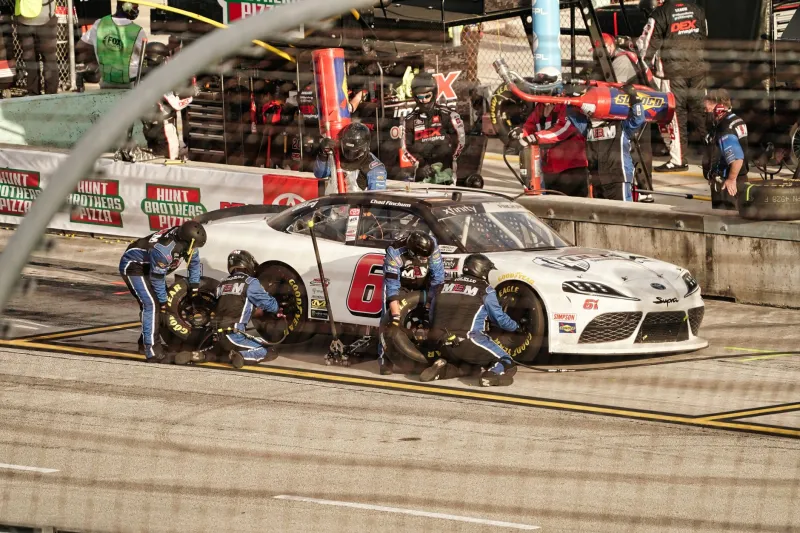
That image is almost impossible to reconcile with the pit lane of a modern NASCAR Cup race, where a seven-person team executes a complete four-tire change and fuel stop in under twelve seconds, every movement rehearsed thousands of times, every hand placement optimized by biomechanics coaches. Same sport. Completely different universe.
When a Pit Stop Took Longer Than Your Lunch Break
In the 1950s and early 1960s, a full pit stop in American oval racing could eat up three to five minutes without anyone raising an eyebrow. There was no standardized crew size, no regulated equipment, and no universal playbook. Teams showed up with whoever they could find — brothers, cousins, local mechanics who knew the car — and improvised their way through whatever the race threw at them.
Fuel came from gravity-fed cans. Tires were changed with hand-operated tools. If something broke mid-stop, you fixed it right there, on the spot, with what you had in the toolbox. The crew chief wasn't following a data-driven script — he was making gut calls based on how the car sounded, how the driver looked when he climbed out, and forty years of mechanical intuition.
This wasn't inefficiency. It was a different kind of skill entirely. Teams that won races in that era weren't just fast on the track — they were resourceful in the pits. A well-run stop in 1962 might save you ninety seconds over a rival who fumbled a wheel nut. That was the race right there. Mechanical ingenuity was as much a competitive weapon as horsepower.
The Slow March Toward Precision
Things started changing seriously in the late 1960s and through the 1970s, as teams began treating the pit stop less like an emergency repair situation and more like a choreographed operation. Crew members started practicing stops outside of race weekends. Roles became more defined — the tire carrier, the jackman, the fuel man — each person responsible for one specific task and nothing else.
By the 1980s, NASCAR pit crews were beginning to look recognizable by modern standards. Stopwatches were everywhere. Air-powered wrenches replaced hand tools. Teams started timing their stops obsessively and comparing notes. The era of the accidental pit crew genius was giving way to the era of the professional pit crew athlete.
And make no mistake — that's exactly what they became. By the 1990s, top NASCAR teams were recruiting former college football players and gymnasts specifically for pit crew roles. The physical demands were enormous: jackmen lifting 80 pounds of race car in under a second, tire carriers sprinting in full gear, over-the-wall crew members executing movements with the precision of a surgical team. These weren't mechanics anymore. They were specialists.
The Modern Pit Stop Is a Different Sport Entirely
Watch a Formula 1 pit stop today and your brain genuinely struggles to process what happened. The record sits at under two seconds for a four-tire change — a number that would have sounded like science fiction to a 1960s NASCAR crew chief. IndyCar and NASCAR stops aren't quite that extreme, but the gap between then and now is still staggering.
Modern teams use pneumatic wheel guns calibrated to specific torque values. Crew members train year-round on practice rigs that replicate pit lane conditions exactly. Data from every stop is reviewed frame by frame, looking for hundredths of a second that can be recovered. Some teams use motion-capture technology to analyze crew movement. There are pit stop coaches whose entire job is optimizing the choreography.
The car itself has evolved to accommodate this obsession with speed. Wheel fasteners, fuel rigs, jack points — everything is engineered with the stop in mind. Nothing is left to chance. Nothing is improvised.
What Got Left Behind
Here's the thing nobody really talks about: when pit stops became a science, they stopped being a story.
In the old days, a race could turn on a crew chief's inspired decision to take four tires when everyone else took two, or on a mechanic who spotted a hairline crack in a suspension component during a stop and fixed it before it became a crash. Those moments had drama because they were human — unpredictable, fallible, brilliant in ways that couldn't be planned.
Now, the drama is still there, but it's different. A dropped wheel gun, a fuel valve that sticks, a crew member who clips the car on the way out — these are the errors that decide modern races. The bar for "good" is so high that anything less than perfect reads as catastrophic failure.
The grease-stained mechanic who could rebuild a carburetor between laps has been replaced by a cross-fit athlete who trains specifically to sprint twelve feet and hit a wheel nut in 0.9 seconds. Both are impressive. But only one of them feels like it belongs in a story your grandfather would tell.
Maybe that's the real shift. Racing used to test mechanical ingenuity as much as driving talent. The garage was where championships were built, in the dark, with dirty hands and better ideas than the other guy. Today, the garage is a controlled environment of engineered certainty — and the race is almost entirely won before the green flag drops.
That's progress. But it's also a goodbye to something that made early American motorsport feel genuinely wild.