Grease Under the Fingernails: The Lost Rite of Passage That Taught a Generation to Think With Their Hands
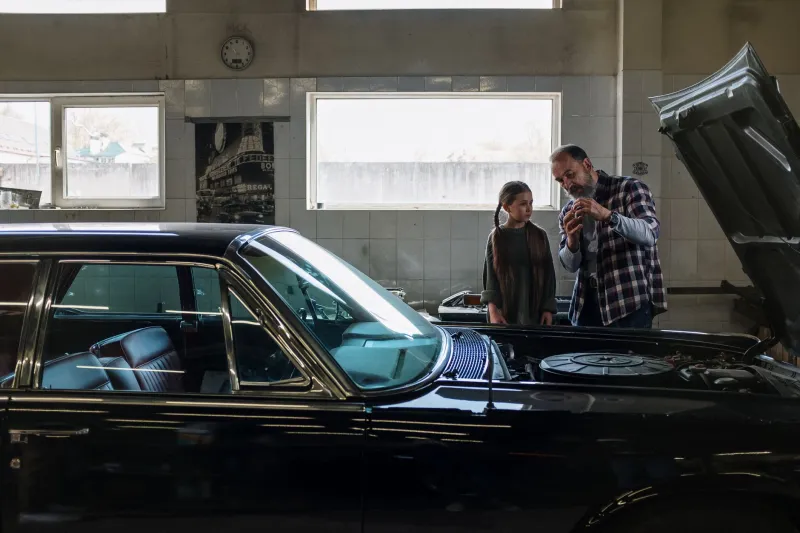
Ask someone who came of age in the 1960s what they remember about being sixteen, and somewhere in the answer — between the music and the freedom and the first real sense of independence — you'll almost always find a garage. A particular smell of oil and concrete. A father or uncle or older brother leaning over an open hood, pointing at something and saying: Now you try.
For much of the twentieth century, mechanical literacy wasn't a hobby. It was a baseline expectation. If you drove a car, you were expected to understand it well enough to keep it running — and when it didn't run, you were expected to figure out why.
That expectation quietly shaped an entire generation in ways that went far beyond automotive knowledge.
The Car as Classroom
In the postwar decades, the average American car was a masterclass in mechanical accessibility. Lift the hood of a 1955 Chevy and you saw an engine you could actually read — a large, logically arranged collection of components with enough space between them to fit two hands and a basic understanding of how combustion worked. The carburetor sat right there. The distributor was obvious. The spark plugs were reachable without a specialty tool or a lift.
This wasn't accidental. Cars were designed to be maintained by their owners, because the alternative — paying a shop for every hiccup — was expensive in a way that didn't fit postwar middle-class budgets. Necessity created competence, and competence created confidence.
Teenagers absorbed this by proximity. If your dad spent Sunday afternoons under the hood, you eventually ended up under there with him. Not always willingly. Not always with enthusiasm. But the knowledge transferred anyway, the way most important knowledge does — through repetition and observation and being handed a wrench before you fully understood why.
What You Actually Learned When You Learned to Fix a Carburetor
Here's the thing about mechanical work that nobody ever quite said out loud: it wasn't really about the carburetor. The carburetor was the excuse.
What you actually learned was how to diagnose a problem when the symptoms were ambiguous. You learned that the obvious answer is sometimes right and sometimes a decoy. You learned that patience — real, sustained patience, the kind that keeps you lying on a cold garage floor for two hours — is a skill you can build deliberately. You learned how to manage frustration when something doesn't cooperate, because a stripped bolt doesn't care about your feelings and neither does a stuck valve.
You learned, maybe most importantly, that complex systems have logic — that nothing breaks randomly, that there is always a reason, and that finding the reason is a process you can learn.
These aren't automotive lessons. They're life lessons wearing coveralls.
The Saturday Morning Ritual
For millions of American families in the fifties, sixties, and seventies, Saturday mornings had a particular rhythm. Cartoons for the little kids. Chores. And then, for the teenagers, the garage.
Maybe it was a '63 Falcon that needed a valve adjustment. Maybe it was a '68 Mustang with a carburetor that ran rich at idle. Maybe it was just an oil change on the family station wagon — routine maintenance that cost nothing but time and a few dollars in supplies, compared to whatever the shop would have charged.
The specific job mattered less than the ritual itself. Father and son, or uncle and nephew, or two brothers with a Chilton manual and a Saturday afternoon — working through a problem together, with their hands, in real time. No screens. No abstraction. Just metal and cause and effect.
Girls weren't always included in this ritual, and that's a real loss worth naming. The mechanical confidence that those Saturday mornings built was disproportionately handed to young men, and the broader culture was poorer for it. But within the households where it happened across gender lines — and they existed — the effect was identical: practical intelligence, quietly installed.
When the Engines Became Black Boxes
The shift happened gradually through the 1980s and accelerated sharply in the '90s. Electronic fuel injection replaced carburetors. Onboard diagnostic computers arrived. Engine bays filled up with plastic covers and tightly packed components that required specialist tools, factory software, and calibrated sensors to service correctly.
This wasn't a conspiracy. It was progress. Electronic systems genuinely made cars more reliable, more efficient, and cleaner. The tradeoff — reduced owner accessibility — was real but defensible. You don't fix a modern turbocharged direct-injection engine with a Chilton manual and a socket set. You plug in a diagnostic reader, interpret fault codes, and in many cases, accept that certain repairs require dealership-level equipment.
The practical result, though, was that the garage stopped being a classroom. There was nothing obvious to point at under a modern hood. No component a teenager could remove, examine, understand, and reinstall. The car became a sealed system — extraordinarily capable and almost completely opaque.
And without the car as a teaching tool, the rite of passage evaporated.
What Filled the Gap — and What Didn't
It would be unfair to say that today's teenagers don't develop practical intelligence. They do — through coding, through building computers, through electronics projects and fabrication hobbies that would have been inaccessible to previous generations. The maker movement has done real work in this space.
But there's something specific that physical mechanical work provides that digital work doesn't fully replicate: the experience of a problem that resists you physically. A bolt that won't break loose. A gasket that doesn't seat correctly. A system that runs differently in cold weather than warm. These aren't abstract puzzles — they're material realities that require persistence, adaptation, and a tolerance for getting it wrong before you get it right.
The garage taught that failure is not the end of the process. It's part of the process. That's a lesson that translates everywhere, and it was being taught to millions of American teenagers every weekend for decades — disguised as an oil change.
The Inheritance We Didn't Know We Were Receiving
Ask that same person who came of age in the '60s what the garage actually gave them, and they'll probably pause before answering. Because they didn't think of it as giving them anything. It was just what you did. It was just how things worked.
That's the nature of the best kinds of learning. It doesn't announce itself. It just becomes part of how you approach problems — methodically, patiently, with your hands as much as your head — long after the specific skill that taught it has become obsolete.
The carburetor is gone. But the generation it trained is still out there, and you can usually spot them. They're the ones who, when something breaks, don't immediately reach for their phone. They reach for a way to understand it first.