The Speed You Can't Feel: How Modern Cars Made Breaking the Law Completely Comfortable

There's a particular kind of shock that comes from glancing at your speedometer and realizing you're doing 82 in a 65. No vibration warned you. No wind noise climbed. The engine didn't strain. The road didn't blur. You were just... going fast, in complete, climate-controlled comfort, with a playlist shuffling in the background and zero physical indication that anything unusual was happening.
This is one of the stranger unintended consequences of automotive progress. We built cars so refined, so insulated, so mechanically composed at high speed that we essentially removed the body's ability to self-regulate on the road. And then we kept the speed limits roughly where they were.
The Early Days: When Speed Felt Like Speed
Speed limits in America are almost as old as the automobile itself. Connecticut introduced the country's first statewide limit in 1901 — a brisk 12 mph in cities, 15 mph on rural roads. The concern wasn't highway safety in any modern sense; it was pedestrians, horses, and the general chaos of a machine nobody quite knew how to integrate into daily life yet.
As cars became faster and roads improved, limits climbed cautiously. By the 1950s and 1960s, most interstate highways were operating under limits in the 65–70 mph range, though enforcement was inconsistent at best and nonexistent in long rural stretches.
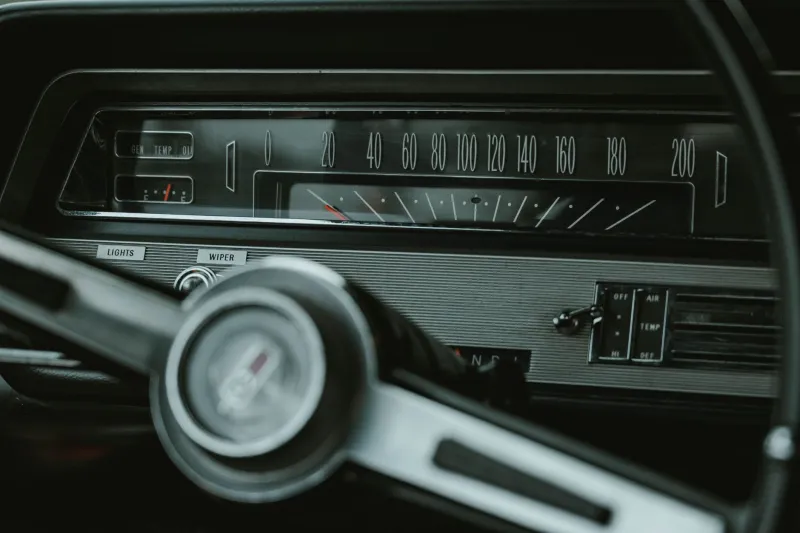
Here's the thing about driving 70 mph in a 1962 Chevrolet Impala: you knew about it. The steering wheel vibrated. The cabin roared. Wind found every seal and gap in the body. The suspension communicated every imperfection in the road surface directly to your hands and spine. Speed was a physical experience. Your body had real-time data. Going fast felt like going fast, and that sensation carried its own natural governor.
The 55 Era and the National Experiment
The 1973 oil crisis didn't just reshape the gas station — it also reshaped the speed limit. Congress passed the National Maximum Speed Law in 1974, capping all highway speeds at 55 mph nationwide. The stated rationale was fuel conservation, but highway fatality rates did drop significantly in the years that followed, a correlation that generated decades of debate about how much of that was the speed limit versus safer cars, seatbelt adoption, and other factors.
The 55 mph limit was deeply unpopular, especially in western states where distances were vast and 55 felt like a crawl. Compliance was notoriously low. The radar detector industry boomed. CB radios became the communication network of choice for drivers warning each other about speed traps — a whole subculture built around the collective refusal to slow down.
Congress eventually relented. The 1987 Surface Transportation and Uniform Relocation Assistance Act allowed states to raise limits to 65 mph on rural interstates. The 1995 repeal of the national maximum eliminated federal oversight of speed limits entirely, and states began setting their own. Today, Texas has stretches of highway posted at 85 mph — the highest legal speed limit in the United States.
What Engineering Did to Our Instincts
While the regulatory framework was shifting, something equally significant was happening inside the cars themselves. Each decade brought quieter cabins, stiffer chassis, better tires, more sophisticated suspensions, and more powerful engines that delivered their output with less drama. Air conditioning became standard. Then sound insulation improved. Then active noise cancellation arrived. Then adaptive cruise control started managing speed for you.
The result is a modern vehicle that is, in purely sensory terms, almost deceptive about its own velocity. A well-sorted mid-size sedan today — nothing exotic, nothing particularly sporty — can cruise at 80 mph with less noise, less vibration, and less driver effort than a performance car from the 1970s managed at 60. The feedback loop between driver and road that once kept people instinctively aware of their speed has been systematically smoothed away.
Studies have consistently shown that drivers underestimate their speed more frequently in modern vehicles than in older ones. The engineering that makes a car pleasant to drive at legal speeds also makes it pleasant to drive at illegal ones. There's no discomfort trigger. No natural threshold where your body starts sending warning signals.
Enforcement Caught Up — Sort Of
Law enforcement has responded to the speeding problem with its own wave of technology. Speed cameras, automated ticketing systems, LIDAR guns, and aerial enforcement have all expanded the reach of traffic law beyond what any patrol car fleet could manage alone. Some municipalities generate significant revenue from automated speed enforcement, which has created its own political controversies about whether the goal is safety or income.
The penalties have escalated too. In many states, exceeding the limit by 20 mph or more qualifies as reckless driving — a criminal charge in some jurisdictions, not just a traffic infraction. License points, insurance surcharges, and mandatory court appearances have raised the stakes considerably compared to the relatively casual enforcement environment of the 1960s and 1970s.
And yet speeding remains among the most common traffic violations in the country. The gap between the law and driver behavior has, if anything, widened. Speed cameras in residential areas routinely catch the majority of passing vehicles exceeding the posted limit. On interstates, driving with traffic often means driving above the limit, and driving exactly at the limit can feel — and sometimes be — a hazard in itself.
The Comfort Paradox
What we've arrived at is a genuinely strange situation. Cars are safer than ever. Roads are better than ever. Speed limits are, in many places, more thoughtfully calibrated than they've historically been. Enforcement is more sophisticated. And yet the sensory experience of driving has become so detached from the physical reality of speed that the natural feedback mechanisms humans relied on for self-regulation have largely stopped working.
We built our way out of feeling fast. And now we're writing tickets for it.