Needles, Guesses, and the Numbers We Just Trusted: The Long Road to Dashboard Honesty
There's a photograph somewhere in almost every American family's archive — a road trip shot from the 1960s or 70s, somebody's dad behind the wheel, one hand loose on the steering column, confident as anything. He had no idea how fast he was actually going. Neither did anyone else on the road. And somehow, the whole country just kept moving.
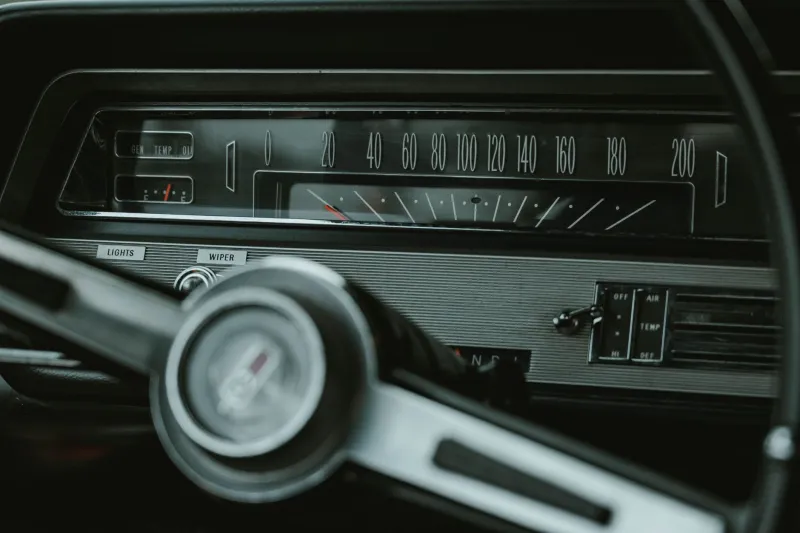
For most of the twentieth century, the instruments mounted in your dashboard were performing a kind of theater. They looked authoritative. They had needles and numbers and satisfying little tick marks. But underneath that chrome-ringed confidence was a mechanical system so imprecise that federal regulators eventually had to step in and set minimum accuracy standards — because manufacturers had been letting drivers operate in a fog of numerical fiction for decades.
The Margin Nobody Talked About
Here's the part that tends to surprise people: a speedometer reading 60 mph in a car from the 1950s or early 1960s might have been measuring anywhere from 52 to 68 mph in reality. That's not a manufacturing defect. That was the acceptable range. Cable-driven speedometers — the mechanical standard for most of the century — were vulnerable to everything from tire wear and inflation pressure to cable stretch and differential gear ratios. Change your tire size and your speedometer became a different instrument entirely, one that nobody recalibrated.
Fuel gauges were arguably worse. The float mechanism inside the gas tank that fed information to the needle on your dash was a simple, dumb system that responded slowly, read differently on hills, and had a well-earned reputation for crying wolf. Every driver from that era has a story about running dry despite the needle sitting stubbornly above E. The "E" didn't really mean empty — it meant probably getting close, good luck out there.
Odometers, meanwhile, accumulated the same errors as speedometers, since they drew from the same cable system. Drive 100,000 miles on undersized tires and your odometer might read 97,000. It mattered at resale. It mattered for maintenance intervals. Mostly, people just shrugged.
Why Nobody Really Complained
The honest answer is that drivers calibrated themselves to the imprecision. You learned that your car ran a little hot on the temp gauge, that the fuel needle dropped fast in the first quarter and then seemed to stall forever in the second. You developed a personal translation layer between what the instruments said and what was actually happening. It was intuitive, even intimate — a relationship between driver and machine that required active attention and a degree of accumulated knowledge.
Speed enforcement helped reinforce the habit. Traffic cops weren't operating LIDAR guns in 1962. Radar was emerging but inconsistent. The margin of error in instruments matched, more or less, the margin of tolerance in enforcement. Going 58 in a 55 zone wasn't a crisis when nobody — not you, not the officer — could be certain of the exact number anyway.
There was also a cultural component. Americans in the postwar decades were broadly comfortable with approximation in everyday life. You estimated your bank balance, guessed at cooking measurements, eyeballed distances. Precision was for engineers and scientists. The rest of us got by on feel.
The Regulatory Turn
Things started shifting in the 1970s. The oil crisis forced Americans to actually think about fuel consumption in ways they never had before, and suddenly the vagueness of fuel gauges felt less charming and more frustrating. Congress passed legislation tightening speedometer accuracy requirements. Electronic fuel injection, which began its slow takeover of American engines through the late 70s and into the 80s, allowed for dramatically more precise fuel measurement as a byproduct of how the systems worked.
By the 1990s, digital instrumentation was creeping into higher-end vehicles. Instead of a cable spinning a needle, sensors were sending voltage signals to microprocessors. The lag disappeared. The drift disappeared. The personal translation layer that drivers had maintained for generations started to become unnecessary.
When the Needle Became a Number
Today's vehicles operate in a different universe. GPS-integrated speedometers cross-reference satellite positioning data with wheel-speed sensors, producing readings accurate to within a fraction of a mile per hour. Fuel range estimates factor in recent driving behavior, terrain data, and current load. Trip computers track consumption in real time, displaying it as a live number that updates with every throttle input.
The modern dashboard doesn't ask you to trust it. It proves itself, constantly, with a specificity that would have seemed like science fiction to the guy in that road trip photograph.
And yet something shifted in the relationship. When the instruments were imprecise, drivers stayed engaged. You watched. You felt. You compensated. Now, the car simply tells you, and the telling is so comprehensive that many drivers have stopped developing any intuition at all. Run low on fuel and the screen shows a countdown in miles. The gauge isn't a gauge anymore — it's a notification.
More Informed, More Anxious
Precision has a side effect that nobody really anticipated: it creates anxiety proportional to the data available. When your fuel gauge was a suggestion, you didn't stress about the exact number. Now, drivers report genuine tension watching a range estimate tick down on a long stretch of interstate, even when they're objectively fine on fuel. The same applies to tire pressure sensors, battery warnings, and service reminders — every metric now visible, trackable, and capable of generating low-grade stress.
We traded comfortable ignorance for accurate discomfort, and by almost any safety measure, it was the right trade. Fewer drivers run out of gas. Fewer people get tickets for speeds they didn't know they were traveling. Maintenance intervals get hit on time.
But there's something worth acknowledging in the old imprecision — the way it made driving a conversation between person and machine rather than a data readout. You didn't just check a number. You knew your car. That kind of knowledge, built over miles and years, was its own form of accuracy. Just a much slower, more personal one.