The Original Urban Gridlock Was Made of Horses — And It Was Absolutely Catastrophic
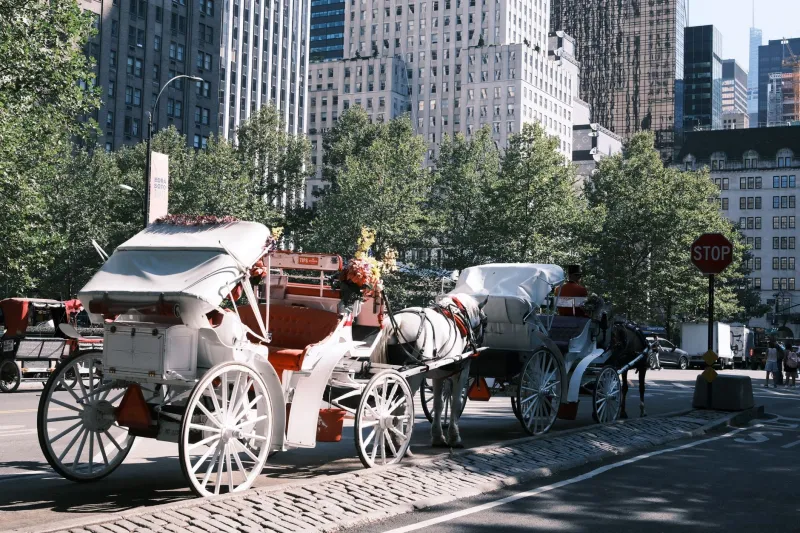
The next time you're sitting in gridlock on the 405 or inching through downtown Chicago at 5 p.m., try to remember that traffic jams are not a modern invention. Americans were cursing at congestion long before anyone invented the internal combustion engine.
They were just cursing at horses.
In the final decades of the 1800s, American cities faced a transportation crisis so severe, so pungent, and so genuinely dangerous that urban planners and public health officials believed it might literally be unsolvable. The horse-powered city was collapsing under its own weight — and the automobile, when it finally arrived, was greeted not as a nuisance but as a salvation.
That context has been almost entirely forgotten. And it changes everything about how we think about cars.
A City of 150,000 Horses
New York City in 1890 was home to approximately 150,000 horses. They pulled streetcars, delivery wagons, fire engines, milk carts, coal wagons, garbage trucks, and private carriages. The city's entire economy moved on four legs. Without horses, nothing got delivered, no one got anywhere, and the city stopped functioning.
 Photo: New York City, via i.pinimg.com
Chicago had roughly 83,000. Philadelphia had tens of thousands more. Every major American city had built its infrastructure around the horse, and the horse had scaled accordingly — right up to the point where the system began to buckle.
The problem wasn't just the number of animals. It was what those animals left behind.
The Manure Crisis That Almost Broke American Cities
A working horse produces between 15 and 35 pounds of manure per day. In a city of 150,000 horses, that works out to somewhere between 1,125 and 2,625 tons of manure — every single day — landing on city streets, in alleys, in gutters, and eventually in the lungs of everyone who lived there.
In dry weather, the manure dried and pulverized into a fine dust that coated buildings, food stalls, and people. In wet weather, it turned streets into a brown slurry that reached the hubs of wagon wheels. The smell was, by every historical account, overwhelming and inescapable. Contemporary observers described Manhattan's streets as smelling like a giant stable.
This was not a minor inconvenience. It was a genuine public health emergency. Flies bred in the manure by the billions and spread typhoid fever, dysentery, and other diseases throughout the population. The death toll was real and measurable.
And the manure was only part of it.
Dead Horses and the Problem Nobody Talks About
Working horses in late 19th-century American cities had brutal, short lives. The average city horse worked for only about three years before it broke down — from injury, exhaustion, or disease. In New York alone, roughly 15,000 horses died on the streets every year.
Removing a dead horse from a city street was a logistical nightmare. The animals weighed anywhere from 800 to 1,200 pounds, and before they could be moved, they often lay in the street for days while the city's removal crews worked through the backlog. In summer, the decomposition process was rapid and made the surrounding blocks nearly uninhabitable.
Street photography from this era captures something modern viewers find almost incomprehensible: carcasses of horses simply lying in the middle of major thoroughfares, surrounded by pedestrians and traffic going about their day as if this were completely normal.
It was completely normal. That was the problem.
Gridlock Before the Word Existed
Beyond the sanitation catastrophe, the sheer volume of horse-drawn vehicles had created something that looked remarkably familiar to any modern commuter: total, paralyzing gridlock.
Midtown Manhattan in the 1890s could see streets so thoroughly clogged with wagons, streetcars, and carriages that movement stopped entirely for hours. Horses, unlike cars, couldn't simply be turned off — they needed water, they got spooked, they collapsed from exhaustion. A single horse going down in a busy intersection could lock up a dozen blocks of traffic in every direction.
The New York Times ran editorials in the 1890s declaring the city's street situation a crisis with no clear solution. Urban planners held conferences. Engineers proposed elevated roadways, underground tunnels, and elaborate traffic management schemes. Nothing worked for long, because the fundamental problem — too many large animals in too small a space — had no good fix.
In 1894, a London urban planning conference famously predicted that by 1950, every street in London would be buried under nine feet of manure. The math, based on existing growth rates, was technically sound. The prediction was wrong only because something completely unexpected happened: the car.
The Automobile as Environmental Hero
When the first automobiles began appearing on American streets in the late 1890s and early 1900s, the reaction from city dwellers was not uniform horror at the noise and danger — though there was plenty of that. There was also genuine, widespread relief.
Newspapers celebrated the car as a solution to the manure crisis. Public health officials noted that replacing horse-drawn streetcars with electric ones had already dramatically improved air quality in cities that had made the switch. The automobile promised to finish the job.
By 1912, cars outnumbered horses in New York City for the first time. By 1917, the city's horse population had fallen by more than half. The streets got cleaner. The flies decreased. The death rate from horse-related disease dropped measurably.
For a brief, strange window in history, the automobile was the environmentally responsible choice.
The Irony That History Forgot
It's almost impossible to hold this fact in your head alongside everything we know about cars and pollution today. The vehicle we now associate with smog, carbon emissions, and climate change was originally embraced as a clean alternative to the ecological disaster of the horse-powered city.
Neither technology was inherently good or bad. Both were solutions to the problems of their moment — and both created new problems that the next generation would have to solve.
The horse didn't disappear because Americans stopped loving horses. It disappeared because the cities horses had built had grown too big for horses to run.
The car stepped in, cleaned up the streets, and then, over the next century, created an entirely new set of problems that would have seemed just as unimaginable to a New Yorker dodging manure in 1895 as their world would seem to us.
Every era's solution is the next era's crisis. We're just living in the next era.