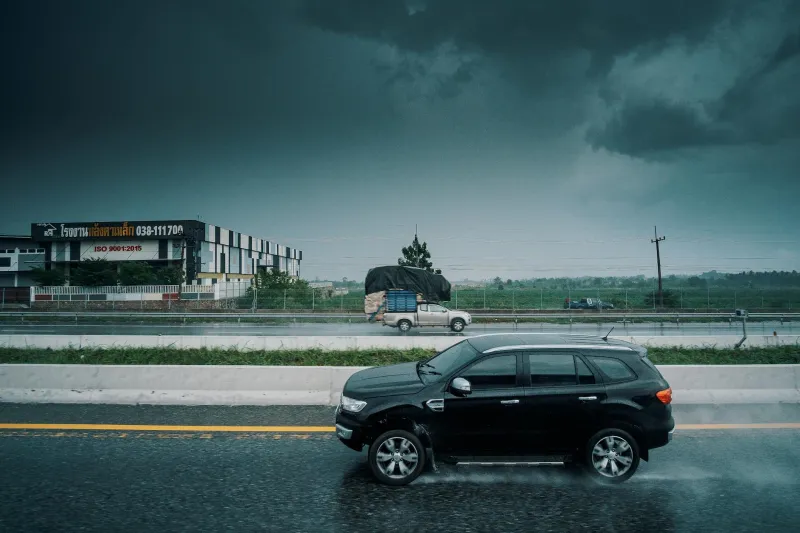
Pull out your phone right now. Check the weather. You probably see an hourly breakdown, radar maps, and severe weather alerts stretching days into the future. Now imagine making a 500-mile drive across Kansas without any of that information — armed only with what you could see through your windshield and whatever your grandfather taught you about reading clouds.
That was reality for American drivers until shockingly recently. Before weather apps became our digital crystal balls, every person behind the wheel was an amateur meteorologist, forced to decode the sky's moods using nothing but observation, intuition, and folklore passed down through generations.
The Dashboard Weather Station
In 1960, the average American driver possessed weather-reading skills that would seem supernatural today. They could spot the difference between harmless cumulus clouds and the menacing wall clouds that spawn tornadoes. They knew that a sudden drop in temperature meant trouble was brewing, and that green-tinged skies in the Midwest weren't just pretty — they were a warning to find shelter immediately.
Car trips required constant sky surveillance. Drivers would pull over to study cloud formations, debate whether that distant darkness was rain or just shadows, and make split-second decisions about whether to push forward or turn back. Gas station attendants doubled as weather consultants, sharing local knowledge about seasonal patterns and storm behavior.
The really skilled drivers developed an almost mystical ability to predict weather hours in advance. They'd notice the way leaves turned silver before a storm, how the air felt heavy and still, or how distant mountains disappeared behind a particular type of haze. These weren't old wives' tales — they were survival skills.
When Your Gut Was Your Radar
Before Doppler radar became household technology in the 1990s, Americans relied on folk wisdom that sounds absurd today. "Red sky at night, sailor's delight" wasn't just a cute rhyme — it was meteorological guidance that determined whether you'd risk driving to the next town. Farmers and truckers developed elaborate systems for reading atmospheric pressure through body aches, animal behavior, and the smell of the air.
Long-distance travelers became experts at interpreting regional weather patterns. They knew that afternoon thunderstorms in Florida were as predictable as sunrise, that mountain weather could turn deadly in minutes, and that winter driving in Minnesota required reading snow clouds like tea leaves. Missing these cues could mean getting caught in a blizzard with no warning system beyond your own eyes.
The most experienced drivers carried barometers and taught their kids to watch for "mackerel skies" — those wispy, fish-scale clouds that promised weather changes within 24 hours. Truckers shared weather intelligence over CB radios, creating informal networks that rivaled anything the National Weather Service could provide.
The Digital Takeover
Everything changed when weather became data instead of observation. The Weather Channel launched in 1982, bringing professional meteorology into living rooms. By the 2000s, websites offered detailed forecasts. Then smartphones put radar maps in every pocket, complete with minute-by-minute precipitation predictions and push notifications for severe weather.
 Photo: The Weather Channel, via logodix.com
Suddenly, the sky became irrelevant. Why scan clouds when your phone could tell you exactly when rain would start? Why learn to read atmospheric pressure when an app provided hourly breakdowns? The ancient human skill of weather prediction withered from disuse.
Today's drivers trust their phones over their senses, even when the evidence contradicts digital predictions. They'll drive into obvious storm conditions because their weather app shows clear skies, or panic about forecasted rain while the sun shines overhead. We've traded intuition for information — and lost something profound in the process.
What We Lost in Translation
The death of weather-reading skills represents more than technological convenience. It's the loss of a fundamental connection between humans and their environment. Our ancestors survived by understanding natural patterns, reading subtle environmental cues, and trusting hard-earned wisdom about local conditions.
Modern weather prediction is incredibly accurate, but it's also generic. Apps can't tell you that this particular valley always gets hit harder than forecasts suggest, or that storms in your area typically arrive two hours earlier than predicted. That knowledge died with the last generation of drivers who learned to read the sky.
We've also lost the shared experience of weather uncertainty. Families once huddled around radios during storm watches, making collective decisions about travel safety. Now we check individual phones and assume technology will keep us safe, even when common sense suggests otherwise.
The Sky Still Tells Stories
The irony is that weather-reading skills remain as useful as ever. Digital forecasts can be wrong, cell towers can fail, and apps can crash. But clouds still form the same way they did a century ago, and atmospheric pressure still behaves according to ancient patterns.
Some long-haul truckers and farmers still practice these skills, reading the sky like a book their grandparents taught them to understand. They know things that no app can teach: how the light changes before a tornado, what wind shifts really mean, and why certain cloud formations spell trouble regardless of what the forecast says.
The next time you're driving and notice an interesting cloud formation, try to read it instead of reaching for your phone. Ask yourself what the sky is trying to tell you. You might discover that humans spent millennia developing these skills for good reason — and that some ancient wisdom is worth preserving, even in our hyper-connected age.