When Main Street Lived on the Highway: America's Lost Roadside Villages
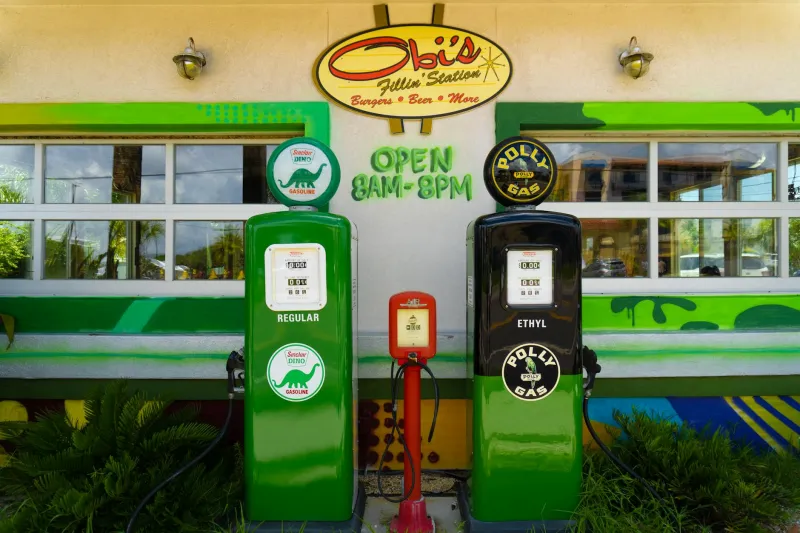
When Main Street Lived on the Highway: America's Lost Roadside Villages
Picture this: You're driving cross-country in 1955, and every 20 miles or so, you roll into a cluster of buildings that seems to have everything you could possibly need. There's a Texaco station where the owner knows your name by your second visit, a diner serving pie that's genuinely better than your grandmother's, a motor court with hand-painted signs, and somehow — impossibly by today's standards — the same guy who pumps your gas also cashes your paycheck and holds your mail.
This wasn't vacation nostalgia. This was how America actually worked.
The Highway as Main Street
Before the Interstate Highway System carved its efficient path across the continent, America's primary roads weren't designed to bypass towns — they were designed to connect them. Route 66, US-1, the Lincoln Highway, and dozens of other federal routes didn't just pass through communities; they became the commercial spine of entire regions.
These weren't the sprawling truck stops we know today. We're talking about genuine micro-economies that sprouted wherever two highways crossed or where a mountain pass forced everyone to slow down. A typical roadside cluster might include a filling station, a café, a motor lodge, a general store, and often a garage that doubled as the local post office or Western Union office.
The economics were beautifully simple: Everyone driving long distances had to stop. There was no other choice. No bypasses, no drive-throughs designed for 70-mph efficiency. If you needed gas, food, or a place to sleep between Chicago and Los Angeles, you were going to interact with dozens of small business owners who'd built their entire lives around that captive audience.
More Than Just Business
What made these roadside communities remarkable wasn't just their commercial function — it was how they became genuine social institutions. The owner of Murphy's Texaco in some forgotten corner of Kansas wasn't just selling gasoline. He was extending credit to traveling salesmen, holding packages for regular customers, providing local directions that no map could offer, and often serving as an informal bank for truckers who needed to wire money home.
Restaurant owners along major routes developed reputations that spread by word of mouth across entire regions. Truckers would plan their routes around specific diners, not because the food was cheap, but because it was consistently excellent. These weren't corporate franchises following standardized recipes — they were family operations where the same cook might work the grill for thirty years, perfecting a chicken-fried steak recipe that became legendary among long-haul drivers.
Motel owners often knew their regular customers' preferences better than modern hotels know their platinum members. They'd save specific rooms, remember dietary restrictions, and provide the kind of personalized service that today seems impossibly expensive to deliver.
The Great Bypassing
Then came the interstates, and everything changed almost overnight.
The Interstate Highway System, launched in 1956, was designed with military efficiency in mind. The goal was to move people and goods as quickly as possible between major cities, which meant eliminating the very thing that made roadside communities viable: the requirement to slow down.
Sudenly, a drive from Chicago to Los Angeles didn't require stopping in dozens of small towns. Travelers could blast past entire regions at 70 mph, stopping only at strategically placed interchanges where corporate chains had the capital to build large-scale operations designed for maximum throughput.
The transition wasn't gradual — it was brutal. Towns that had thrived for decades found themselves literally bypassed, sometimes by just a few miles, but it might as well have been a thousand. Traffic volumes on old highways dropped by 80% or more almost immediately after parallel interstates opened.
What We Actually Lost
The collapse of roadside America wasn't just about business failures — it was about the destruction of an entire economic ecosystem that had supported hundreds of thousands of families and provided genuine community services in places too small for traditional banks, post offices, or restaurants.
These businesses had evolved to fill gaps in rural infrastructure. When they disappeared, many of those gaps simply reopened. Small towns lost not just their economic base, but their connection to the broader world. The informal networks that had carried information, money, and goods along America's highways vanished, leaving many rural communities more isolated than they'd been since the railroad era.
Today, driving across America means experiencing a fundamentally different relationship with place and community. We can cross entire states while interacting only with corporate employees following standardized scripts. We've gained efficiency and consistency, but we've lost something harder to quantify: the sense that travel meant genuine encounter with the diversity of American life.
The Ghost Economy
Drive the old highways today, and you'll see the remnants everywhere: abandoned motor courts with their neon signs dark, boarded-up diners with hand-painted menus still visible through dusty windows, filling stations that haven't pumped gas in decades. These aren't just failed businesses — they're the archaeological remains of an entire way of organizing economic life around the simple fact that people had to slow down.
We've built a more efficient America, but efficiency came at a cost we're still calculating. The roadside communities that once dotted our highways weren't just quaint — they were a distributed network of small-scale entrepreneurship that provided economic opportunity in places where corporate America would never think to invest.
Next time you're cruising past another identical interchange lined with the same five chain restaurants, remember: This efficiency is a choice, not inevitability. We used to organize travel around the assumption that slowing down was not just necessary, but valuable. And maybe, in ways we're only beginning to understand, we were right.