When Geography Was a Family Sport: How America Lost the Living Room Road Trip
The Cathedral of Carpet Navigation
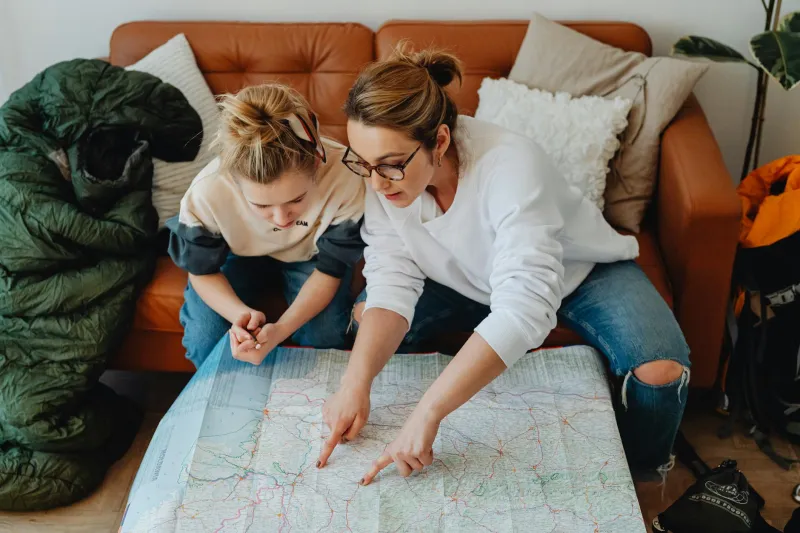
Picture this: It's 1987, and the Thompson family is sprawled across their shag carpet, arguing over a road atlas the size of a coffee table. Dad's finger traces Interstate 40 from Oklahoma City to the Grand Canyon while Mom insists they should take the scenic route through Colorado. The kids are lobbying hard for a detour to Six Flags, armed with a highlighter and the stubborn logic of summer vacation.
This scene played out in millions of American living rooms every summer, a ritual as sacred as Sunday dinner. The family road atlas wasn't just a book—it was a portal to possibility, a canvas for dreams, and often, the source of the trip's first argument.
When Maps Were Mysteries Worth Solving
Before Siri started barking directions, planning a cross-country drive required genuine geographical literacy. Families didn't just pick destinations; they became temporary cartographers, studying elevation changes, calculating mileage, and debating the merits of interstates versus scenic byways.
The Rand McNally Road Atlas was America's unofficial bible of adventure. These massive books, updated annually with the reverence of a sacred text, contained more than just roads—they held the keys to understanding America's physical reality. Parents would quiz kids on state capitals while tracing routes, turning geography from a classroom chore into a treasure hunt.
"We're going to drive through seven states," Dad would announce, as if conquering territories. And in a way, that's exactly what it felt like.
The AAA TripTik: Your Personal Navigation Manuscript
For the truly dedicated, there was the AAA TripTik—a personalized spiral-bound booklet that AAA agents would create by hand, marking your specific route on strip maps. These weren't just directions; they were custom-crafted journey guides, complete with recommended stops, gas stations, and scenic overlooks.
Getting a TripTik meant sitting across from an actual human being who knew roads like a sommelier knows wine. "You'll want to avoid Route 66 through Oklahoma City during rush hour," they'd say, marking alternate routes with a red pen. "And definitely stop at Meramec Caverns—the kids will love it."
These agents were part travel counselor, part geography teacher, part fortune teller. They could predict traffic patterns, recommend restaurants, and warn you about construction delays three states away. It was customer service that actually served customers, not algorithms.
The Lost Art of Route Archaeology
Planning a road trip in the pre-GPS era required skills that have vanished as completely as the dodo bird. Families became amateur archaeologists of America's highway system, learning the difference between interstates, US highways, and state routes. They understood that odd-numbered interstates ran north-south, even-numbered ones ran east-west, and that knowledge felt like possessing secret codes to the American landscape.
Parents would teach kids to read mile markers, explaining how they counted up from state borders. Gas station stops became navigation checkpoints where everyone would gather around the atlas, confirming their position like sailors taking celestial readings.
"We're here," Dad would announce, stabbing the map with his finger, "and we need to be here by lunch." The physical act of pointing, measuring distances with thumbs, and calculating driving times created a tangible relationship with geography that no GPS screen can replicate.
When Getting Lost Was Part of Getting There
Here's the thing modern travelers can barely comprehend: getting lost wasn't a failure—it was part of the adventure. Wrong turns led to unexpected discoveries. The scenic route through small-town America wasn't an Instagram hashtag; it was what happened when you missed your exit and decided to embrace the detour.
Families developed a collective navigation intelligence. Mom became the designated map reader, kids served as mile marker spotters, and Dad maintained executive authority over all route changes. Everyone had a role in the journey's success, creating shared investment in reaching the destination.
Contrast this with today's road trips, where passengers become passive cargo while GPS does all the thinking. We've gained efficiency but lost engagement. The landscape scrolls past like a movie screen instead of unfolding like a story we're actively reading.
The Geography Lessons We Didn't Know We Were Getting
Those living room atlas sessions were stealth education programs. Kids learned that Texas really is that big, that Montana has more square miles than people, and that the Rocky Mountains create a genuine barrier requiring serious route planning. They discovered that America isn't just a concept—it's a vast, complex physical reality with deserts, mountains, rivers, and plains that actually affect how you get from Point A to Point B.
Today's kids know their home address and their school address, and GPS handles everything in between. They're growing up geographically illiterate, unable to navigate by landmarks or understand their position in the larger landscape. We've traded spatial intelligence for turn-by-turn compliance.
The Ritual We Lost
The death of atlas-based trip planning represents more than technological progress—it's the loss of anticipation as an art form. Those carpet sessions built excitement through engagement. Every route decision felt consequential because it was. Choose wrong, and you'd spend an extra day driving through Kansas instead of seeing the Grand Canyon.
Modern road trips begin when you start the car. Pre-GPS road trips began weeks earlier, on the living room floor, with the whole family invested in the journey before anyone turned a key.
We've gained convenience and lost adventure. We've gained efficiency and lost discovery. And somewhere between getting turn-by-turn directions and never getting lost, we stopped being explorers of our own continent.
The atlas is gathering dust in the garage now, but it once held the power to transform ordinary families into navigators of the American dream—one highlighted highway at a time.