When America Bulldozed Its Own Heart: The Interstate Promise That Became Urban Warfare
When America Bulldozed Its Own Heart: The Interstate Promise That Became Urban Warfare
Picture this: It's 1956, and President Eisenhower has just signed the Federal-Aid Highway Act, authorizing the largest public works project in American history. City planners across the country are drawing bold lines on maps, envisioning ribbons of concrete that will transform cramped, congested urban centers into modern marvels of efficiency. The future looks smooth, fast, and inevitable.
What actually happened was something closer to urban carpet bombing.
The Grand Vision That Wasn't So Grand
The Interstate Highway System wasn't just about connecting cities—it was about reimagining them entirely. Urban planners in the 1950s looked at America's dense, walkable neighborhoods and saw obsolescence. These were places where corner grocers knew your name, where kids played stickball in the streets, where three generations might live within a few blocks of each other.
To the highway engineers, these communities looked like traffic jams waiting to happen.
The promise was seductive: superhighways would slice through urban cores, whisking suburban commuters downtown in minutes instead of hours. Property values would soar. Commerce would boom. The American city would finally work the way a modern metropolis should.
Instead, the interstates became concrete barriers that divided cities against themselves, often literally separating white neighborhoods from Black ones, rich areas from poor ones, the politically connected from the politically expendable.
The Human Cost of Concrete Progress
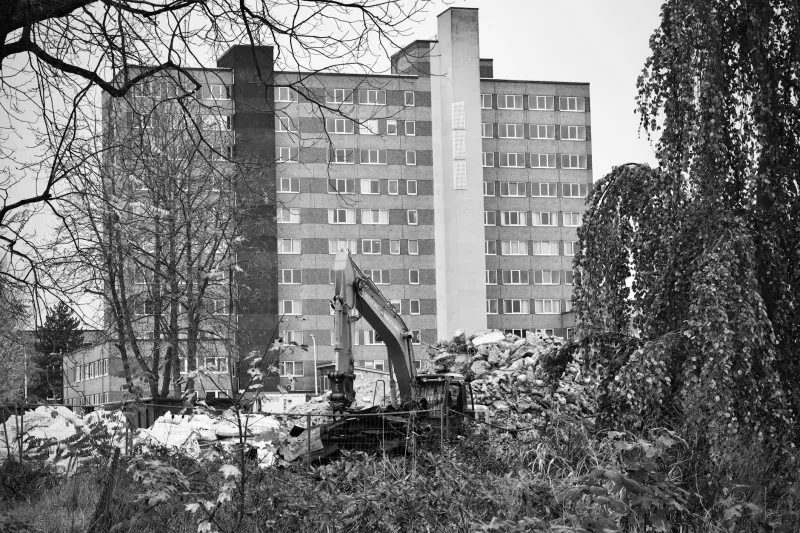
Here's what "urban renewal" actually looked like on the ground: In Detroit, the construction of I-375 demolished the thriving Black Bottom neighborhood, displacing 130,000 residents. In New York, Robert Moses's highway projects uprooted entire communities in the Bronx, contributing to the borough's decades-long decline. In Nashville, Interstate 40 carved straight through the heart of a vibrant Black business district, scattering families and destroying generational wealth.
The numbers are staggering. Nationwide, highway construction displaced an estimated 475,000 families and 100,000 businesses between 1957 and 1977. The overwhelming majority of those displaced were Black families who had few legal protections and even fewer political allies.
These weren't accidents or unintended consequences—they were features of the system. Highway planners routinely chose routes through minority neighborhoods because the land was cheaper, the political resistance was weaker, and frankly, because the people making the decisions didn't live there.
When Speed Became More Important Than Community
The contrast between what was lost and what was gained tells the whole story. Before the interstates, American cities were ecosystems of small businesses, multi-generational families, and pedestrian-scale neighborhoods where you could walk to work, school, and the corner store.
After the interstates, cities became something entirely different: places you drove through to get somewhere else.
The highways did deliver on their promise of speed. A commute that might have taken 45 minutes crawling through city streets could now be completed in 15 minutes of interstate cruising. But that efficiency came at the cost of everything that made urban neighborhoods feel like home.
Corner stores couldn't compete with suburban shopping centers accessible only by car. Local restaurants gave way to chain establishments near highway off-ramps. The informal networks of neighbors, relatives, and longtime residents that had held communities together were scattered to the suburbs or pushed into increasingly isolated pockets of the inner city.
The Reckoning Decades in the Making
By the 1970s, it was becoming clear that something had gone terribly wrong. The highways that were supposed to revitalize cities had instead accelerated their decline. Downtown cores that had bustled with pedestrian life became concrete canyons flanked by parking lots. The urban tax base fled to the suburbs, leaving cities struggling to maintain basic services.
But perhaps most damaging was the way the interstates had hardened racial and economic segregation. Highways became physical barriers that reinforced social ones, making it easier for white suburban communities to remain isolated from the urban problems their exodus had helped create.
Cities Fight Back Against Their Concrete Scars
Today, a growing number of cities are doing something that would have seemed impossible just a generation ago: they're tearing down the very highways that were once symbols of progress and modernity.
In San Francisco, the demolition of the earthquake-damaged Embarcadero Freeway in the 1990s reconnected the city to its waterfront and sparked a renaissance in downtown development. Rochester, New York, removed a section of Interstate 490 that had divided the city center, replacing it with a tree-lined boulevard that's helped revitalize the urban core.
Seattle is currently spending billions to bury a section of Interstate 99 and reclaim the waterfront it had cut off from the city. Boston's Big Dig, despite its cost overruns and construction problems, successfully buried the Central Artery that had scarred downtown for decades.
These projects represent more than just urban planning—they're acts of municipal healing, attempts to undo damage that seemed permanent and irreversible.
The Speed We Lost Along the Way
The irony is that in our rush to make cities faster, we made them slower in ways that matter more than traffic flow. We slowed the pace of community formation, the speed at which neighbors become friends, the rate at which local businesses can build loyal customer bases.
The interstate system delivered on its promise of connecting distant places quickly. But in doing so, it disconnected nearby places permanently. We gained the ability to drive from coast to coast without stopping, but lost the ability to walk from home to the hardware store without risking our lives.
The highways that were supposed to represent the pinnacle of American progress instead became monuments to the kind of progress that destroys more than it creates. They remind us that the fastest route between two points isn't always worth taking—especially when it runs straight through someone else's home.