How America Paved Paradise and Put Up a Parking Lot — Literally
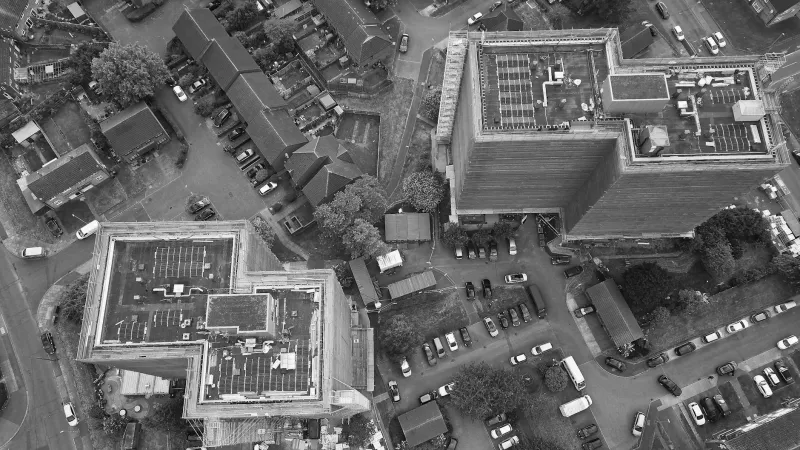
How America Paved Paradise and Put Up a Parking Lot — Literally
If you could travel back to 1940 and walk through downtown Detroit, Chicago, or even a modest city like Portland, Oregon, you'd barely recognize what you were seeing. Streets bustled with pedestrians. Storefronts lined every block in dense, unbroken rows. People lived, worked, and shopped all within walking distance of each other. The American downtown was a concentrated hive of human activity.
Then we fell in love with the automobile. And in our enthusiasm to accommodate our new romance, we did something unprecedented in human history: we systematically demolished our own cities and replaced them with storage space for cars.
The Great Automotive Land Grab
The numbers are staggering in a way that's hard to process. Conservative estimates suggest that parking infrastructure now covers roughly 3.3 million acres of American urban land — an area larger than Connecticut. In some cities, parking consumes more than 30% of all downtown real estate. Los Angeles, the poster child for car-centric development, has dedicated approximately 14% of its entire land area to parking.
But here's the thing that really drives the point home: in 1950, the average American city had about one parking space for every eight residents. Today, that ratio has flipped completely. Many cities now have between two and eight parking spaces for every resident. We've essentially built a parallel city made entirely of empty asphalt, just to store our cars when we're not using them.
When Parking Became Law
This transformation didn't happen by accident. Starting in the 1940s and accelerating through the 1960s, American cities began mandating minimum parking requirements for virtually every new development. Want to build an apartment complex? You need 1.5 parking spaces per unit. Opening a restaurant? Better provide one space for every three seats. Building an office? Plan on one space per 250 square feet.
These requirements, born from a genuine desire to prevent traffic chaos, created an unintended consequence: they made it financially impossible to build the dense, walkable neighborhoods that had defined American cities for centuries. When every new business had to provide its own private parking lot, the continuous streetscape of shops and services that made downtown areas vibrant simply couldn't exist anymore.
Consider this: a single parking space requires about 300 square feet of land when you include access lanes and landscaping. In downtown areas where land might cost $50 per square foot, that's $15,000 worth of real estate dedicated to storing one car. Multiply that by the dozens or hundreds of spaces required for larger developments, and you're looking at enormous chunks of valuable urban land that can never generate property taxes, house families, or contribute to a neighborhood's walkable character.
The Ripple Effect Nobody Saw Coming
The parking mandates created a vicious cycle that reshaped American life in ways planners never anticipated. As businesses spread out to accommodate their required parking lots, distances between destinations increased. As distances increased, walking became impractical. As walking became impractical, car ownership became essential. And as car ownership became essential, the demand for even more parking grew.
Meanwhile, the dense urban neighborhoods that had thrived for generations began to hollow out. Why fight for expensive downtown real estate when you could build a strip mall surrounded by free parking in the suburbs? Why live in a cramped city apartment when you could have a house with a two-car garage twenty minutes away?
The result was a fundamental rewiring of American geography. We didn't just build parking lots — we built a society that required them.
The Hidden Infrastructure of Emptiness
What's particularly striking about America's parking infrastructure is how invisible it's become. We navigate around these vast empty spaces so routinely that we barely register their presence. Yet they've fundamentally altered the texture of American life.
Think about your last trip to a shopping mall, a movie theater, or even a grocery store. Chances are, you spent more time walking across the parking lot than you did walking inside the actual destination. The parking lot has become America's new public square — except it's a public square designed to be empty most of the time, to accommodate peak demand that occurs maybe a few dozen days per year.
The Great Reversal
But something interesting has been happening over the past decade. Cities across America have quietly begun reversing course. Minneapolis eliminated parking minimums entirely in 2021. Buffalo, Hartford, and dozens of other cities have followed suit. San Francisco has been converting parking lots into housing and parks. Even car-centric cities like Houston are beginning to question whether requiring vast seas of parking makes economic sense.
The shift isn't driven by anti-car ideology — it's driven by math. Young Americans are driving less, living in cities more, and increasingly viewing car ownership as an expensive burden rather than a symbol of freedom. Meanwhile, cities are facing housing crises that make dedicating prime real estate to car storage seem increasingly absurd.
What We Lost (And What We're Finding Again)
The story of America's parking lots is ultimately a story about choices we made so gradually that we barely noticed them. We chose convenience over community, speed over serendipity, storage over spontaneity. We built cities optimized for cars rather than humans, and then wondered why urban life felt increasingly isolated and expensive.
But the current reversal suggests something hopeful: that the choices we made can be unmade. Every parking lot converted to housing represents dozens of families who can live in walkable neighborhoods. Every eliminated parking minimum represents a small business that can open without dedicating half its budget to asphalt.
The America that built its cities around parking lots isn't the same America that's questioning those choices today. And maybe that's the most remarkable shift of all.